Teacher Always Make the Nice List: Design Review
First Impressions and Seasonal Appeal
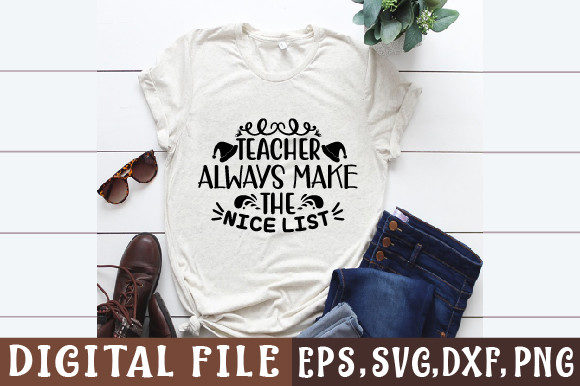
When evaluating Teacher Always Make the Nice List for potential inclusion in a holiday product lineup, the immediate takeaway is its balanced sentimentality. As an experienced designer, I look for graphics that bridge the gap between professional appreciation and festive warmth without tipping into cliché. This design achieves that equilibrium. The typography and layout suggest a playful yet respectful tone, making it highly suitable for T-Shirt Designs and seasonal Graphics. Visually, it carries enough weight to stand alone on a garment but remains open enough to accommodate personalization or additional decorative elements if desired.
The mood this design creates is one of cozy recognition. It acknowledges the hard work educators put in during the chaotic pre-holiday season while offering a lighthearted compliment. For a craft business or Etsy seller, this emotional resonance is critical. Customers are not just buying ink or thread; they are buying a feeling of validation for their favorite teacher. The visual personality feels handcrafted and approachable, which aligns perfectly with the expectations buyers have for a handmade product.
Real-World Application: The Teacher Appreciation Sweatshirt
To truly judge the viability of this asset, I mentally placed it into a specific production scenario: creating a custom crewneck sweatshirt for a school staff holiday party. In this context, Teacher Always Make the Nice List needs to perform as more than just a pretty picture on a screen. It must translate into a tangible custom apparel item that feels premium.
If utilizing this as a machine embroidery design, the lettering requires careful consideration. Script fonts often pose challenges regarding stitch density and legibility at smaller sizes. When planning this project, I would assess whether the text relies on satin stitch columns or fill stitch textures. Satin stitches provide a classic, raised sheen that reads beautifully on fleece, but they demand precise underlay to prevent fabric puckering. If the design includes intricate flourishes, those might need to be executed as a running stitch to maintain clarity without adding excessive bulk.
For those using the provided SVG, DXF, or EPS files for vinyl application or sublimation, the clean lines suggested by the "Print Ready" description are advantageous. However, even in non-embroidery applications, thinking like an embroiderer helps. Ensuring adequate spacing between letters prevents peeling on stretchy knit fabrics. Whether you are producing a tote bag design for library books or a sweatshirt embroidery piece, the design’s composition should allow for centered placement that respects the garment's seams and neckline.
Navigating Fabric Choices and Technical Constraints
Not every substrate is friendly to detailed typography. When working with Teacher Always Make the Nice List, fabric texture plays a massive role in the final outcome. Smooth cotton tees and poly-blend sweatshirts are ideal canvases. However, if you plan to apply this to textured surfaces like terry cloth towels, burlap tote bags, or ribbed knits, caution is necessary. High-texture fabrics can swallow fine details, causing small serifs or connecting script lines to disappear visually.
- Stabilizer Selection: For stretchy knits, always use a cut-away stabilizer to support the weight of the design and prevent distortion over time. Tear-away options may leave residue or fail to support dense satin columns.
- Hoop Size Verification: Before committing to a project, confirm your machine’s maximum field size against the digital file dimensions. Resizing typography too drastically can alter stroke widths and ruin readability.
- Contrast Testing: White thread on cream fabric looks elegant in a mockup but can vanish in real life. Always test thread colors against the actual garment material under natural lighting.
I would also advise against using this specific design on curved surfaces like caps unless you have verified the vertical height. Distortion on the curve of a hat can make horizontal text appear slanted or warped. Similarly, be wary of placing detailed text near seams or collars where the presser foot might struggle to maintain consistent tension.
Commercial Viability and Customer Trust
For small shop product creators and digital sellers, the versatility of this file package is a significant asset. Having access to EPS, SVG, DXF, and PNG formats means you can service multiple customer segments simultaneously. An Etsy seller might use the PNG for a printable mockup to showcase the design on various apparel colors without stitching out every variation. Meanwhile, a local decorator can use the DST or PES conversion (derived from the vector source) for commercial embroidery orders.
However, professional integrity requires due diligence. Because the product description highlights "Digital Download Only" and mentions cutting files for Cricut, you must verify the licensing terms specifically for embroidery digitizing. Just because a file is vector-based does not automatically grant permission to convert it into a proprietary stitch file for resale. Always clarify whether you are selling the finished personalized gift or the digital embroidery file itself. Clear communication about usage rights builds buyer engagement and protects your brand reputation.
From a value perspective, designs that celebrate specific professions tend to have higher conversion rates during peak seasons. Teachers are frequent recipients of holiday embroidery gifts. By offering Teacher Always Make the Nice List on high-quality blanks with professional finishing, you elevate the perceived value beyond a generic novelty item. The design serves as a focal point that signals thoughtfulness, making it an excellent candidate for boutique branding or exclusive seasonal collections.
Essential Pre-Production Checklist
Before listing any item featuring this design or accepting a custom commission, run through this practical evaluation process. These steps separate hobbyist results from professional-grade merchandise.
- Test Stitch-Out: Never skip this step. Run the design on scrap fabric identical to your final product. Inspect registration marks, thread breaks, and overall alignment.
- Mockup Validation: Create black and white versions of your design assets to check contrast independent of color. If the design isn't readable in grayscale, it won't pop in thread.
- Wash Test: If selling baby embroidery items or kitchen textiles, wash and dry the sample. Check for shrinkage, thread loosening, or stabilizer residue.
- Detail Inspection: Zoom in on the smallest elements. Are there jump stitches that need trimming? Is the text spacing consistent? Small flaws become glaring defects on a finished product.
- Licensing Confirmation: Re-read the vendor’s terms. Ensure your intended use (e.g., mass production vs. limited handmade runs) complies with the license.
By treating Teacher Always Make the Nice List with technical respect and creative intention, you transform a simple digital download into a profitable, meaningful product line. Whether applied as a crisp vinyl decal on a tumbler or a lush embroidered patch on an apron, success lies in understanding how the graphic interacts with the physical medium. Practical judgment, combined with seasonal charm, ensures this design earns its place on your own nice list of best-selling assets.